


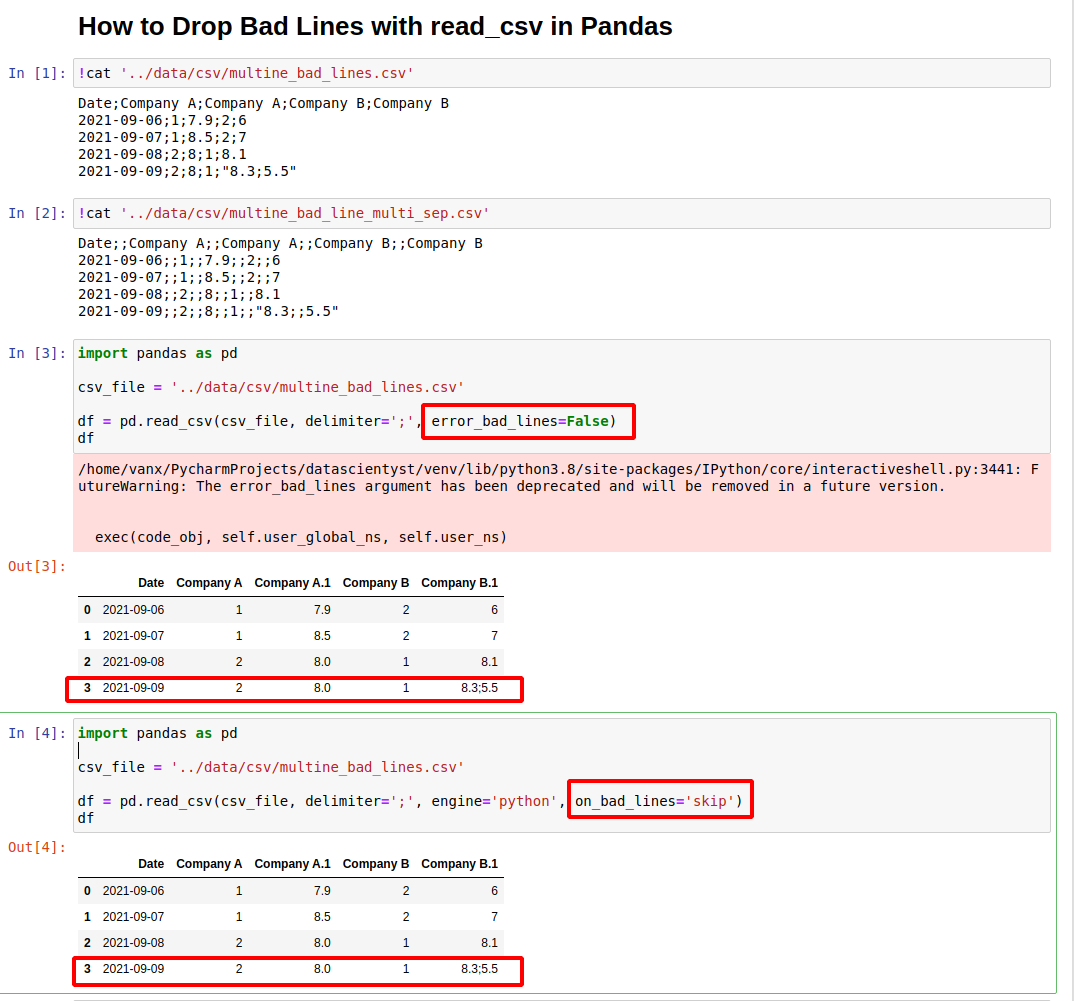
Here are two approaches to drop bad lines with read_csv in Pandas, when on_bad_lines is the only option, since:
error_bad_lineswarn_bad_lines
were removed in pandas 2.0.
(1) Parameter on_bad_lines='skip' — Pandas >= 1.3 (current, recommended)
df = pd.read_csv(csv_file, delimiter=';', on_bad_lines='skip')
(2) error_bad_lines=False — Pandas < 1.3 (removed, do not use)
# ❌ No longer works — raises TypeError on any pandas 2.x install
df = pd.read_csv(csv_file, delimiter=';', error_bad_lines=False)
error_bad_lines and warn_bad_lines were deprecated back in pandas 1.3 and fully removed in pandas 2.0.0. If you still have this in an older script, calling it on a modern pandas version will raise TypeError: read_csv() got an unexpected keyword argument 'error_bad_lines'. There's no fallback or compatibility shim — you need to switch to on_bad_lines.
Suppose we have two files:
-
Single separator
;Date;Company A;Company A;Company B;Company B 2021-09-06;1;7.9;2;6 2021-09-07;1;8.5;2;7 2021-09-08;2;8;1;8.1 2021-09-09;2;8;1;"8.3;5.5" -
Double separator
;;Date;;Company A;;Company A;;Company B;;Company B 2021-09-06;;1;;7.9;;2;;6 2021-09-07;;1;;8.5;;2;;7 2021-09-08;;2;;8;;1;;8.1 2021-09-09;;2;;8;;1;;"8.3;;5.5"
The on_bad_lines parameter
on_bad_lines{'error', 'warn', 'skip'} or callable, default 'error'
Specifies what to do upon encountering a bad line (a line with too many fields). Allowed values are:
error— raise an exception when a bad line is encountered (this is still the default).warn— raise a warning when a bad line is encountered and skip that line.skip— skip bad lines without raising or warning when they are encountered.- callable — since pandas 1.4, you can also pass a function. It receives the bad line as a list of strings and can return a corrected list of fields (to fix the row instead of dropping it), or
Noneto drop it. This only works with theengine='python'parser.
Example of the callable form, useful when you want to repair rather than discard a malformed row:
def fix_row(bad_line):
    # keep only the first 5 fields, drop the rest
    return bad_line[:5]

df = pd.read_csv(csv_file, delimiter=';', engine='python', on_bad_lines=fix_row)
Note that depending on the separator:
- single
- multiple
- regex
the read_csv behavior can be different. You can check this article for more information: How to Use Multiple Char Separator in read_csv in Pandas
The reason for this is described in the pandas documentation:
Note that regex delimiters are prone to ignoring quoted data. Regex example:
'\r\t'.
Any separator longer than one character (like our ;; example) is treated as a regex by the parser, which is why quoted fields containing the delimiter get mis-split — this behavior is unchanged in current pandas.
For example, for a single separator ";" this code will work fine:
| Date | Company A | Company A.1 | Company B | Company B.1 |
|---|---|---|---|---|
| 2021-09-06 | 1 | 7.9 | 2 | 6 |
| 2021-09-07 | 1 | 8.5 | 2 | 7 |
| 2021-09-08 | 2 | 8.0 | 1 | 8.1 |
| 2021-09-09 | 2 | 8.0 | 1 | 8.3;5.5 |
While if you have a file with two separators you will get an error or warning (depending on on_bad_lines) for the quoted line:
csv_file = '../data/csv/multine_bad_line_multi_sep.csv'
df = pd.read_csv(csv_file, delimiter=';;', engine='python', on_bad_lines='warn')
Skipping line 5: Expected 5 fields in line 5, saw 6. Error could possibly be due to quotes being ignored when a multi-char delimiter is used.
In this case only 3 rows will be read from the CSV file:
| Date | Company A | Company A.1 | Company B | Company B.1 |
|---|---|---|---|---|
| 2021-09-06 | 1 | 7.9 | 2 | 6.0 |
| 2021-09-07 | 1 | 8.5 | 2 | 7.0 |
| 2021-09-08 | 2 | 8.0 | 1 | 8.1 |
A quick note on the C vs Python engine
With a single-character delimiter, pandas defaults to the fast C engine, which supports on_bad_lines='error'|'warn'|'skip' natively. With a multi-character or regex delimiter, pandas automatically falls back to engine='python', which is slower but is also the only engine that supports a callable passed to on_bad_lines. If you need to fix (not just skip) bad lines and you're on a single-character delimiter, you must explicitly pass engine='python' yourself, as shown above.